
7th General Election – Preliminary Observation Report
The 7th General Election Mid-Day Observation Report
The Coalition of Ethiopian Civil Society Organizations for Elections (CECOE) has deployed 2,258 sitting observers and 891 mobile observers, totaling 3,149 observers, to conduct Citizen Election Observation for the 7th General Election on June 1, 2026.
The CECOE’s stationary observers began monitoring their assigned polling stations at 5:30 AM to observe the setup and opening of the stations, the voting and counting processes, and the official posting of results at the station level. On the other hand, each mobile observer was assigned to move around and monitor at least six (6) different polling stations.
The deployment of the CECOE’s observers was carried out in constituencies excluding the Tigray region, eight (8) constituencies in the Amhara region, and 5 disputed constituencies. This deployment strategy is based on a proportional observation methodology determined by the number of polling stations in each region.
This mid-day observation report is based solely on the 2,258 polling stations where the CECOE’s stationary observers were deployed. Information gathered from the mobile observers consists only of reports regarding critical incidents. The CECOE Data Center prepared this report based on the observation data received up to 1:00 PM on election day from the 2,258 stationary observers.
Due to expected but delayed data transmission, some observation findings are not included in this report. These delayed reports will be incorporated into the preliminary statement to be released later by the CECOE. This mid-day report is prepared based on ten (10) key indicators across the 2,258 stations where the CECOE’s observers were deployed.
Observation Finding Report on Voter Registration Processes for the Seventh General Elections of Ethiopia , The Coalition of Ethiopian Civil Society Organizations for Elections (CECOE)
The Coalition of Ethiopian Civil Society Organizations for Election (Coalition for Election), under the accreditation obtained from the National Election Board of Ethiopia (NEBE), is observing the Seventh General Elections. The Coalition has deployed 522 long-term observers (LTOs) to observe the voter registration process across all Ethiopian regions and the two city administrations, Addis Ababa and Dire Dawa with the exception of the Tigray region and contested areas.
This report evaluates the voter registration process conducted by the NEBE —assisted by both manual and tablet methods—in a systematic manner using consistent observation checklists based on key indicators. This report primarily examines the voter registration process, its inclusiveness (participation of women, persons with disabilities, and the elderly), the deployment of security forces around registration centers, and election security.
The report covers the voter registration process from March 20, 2026, to the conclusion of registration on April 22, 2026. It is based on findings gathered from 3,953 manual and 443 tablet registration centers, totaling 4,396 centers where the Coalition deployed its 522 long-term observers. Any percentage (%) findings presented in this report are calculated relative to the 3,953 manual and 443 tablet registration centers observed by the Coalition.
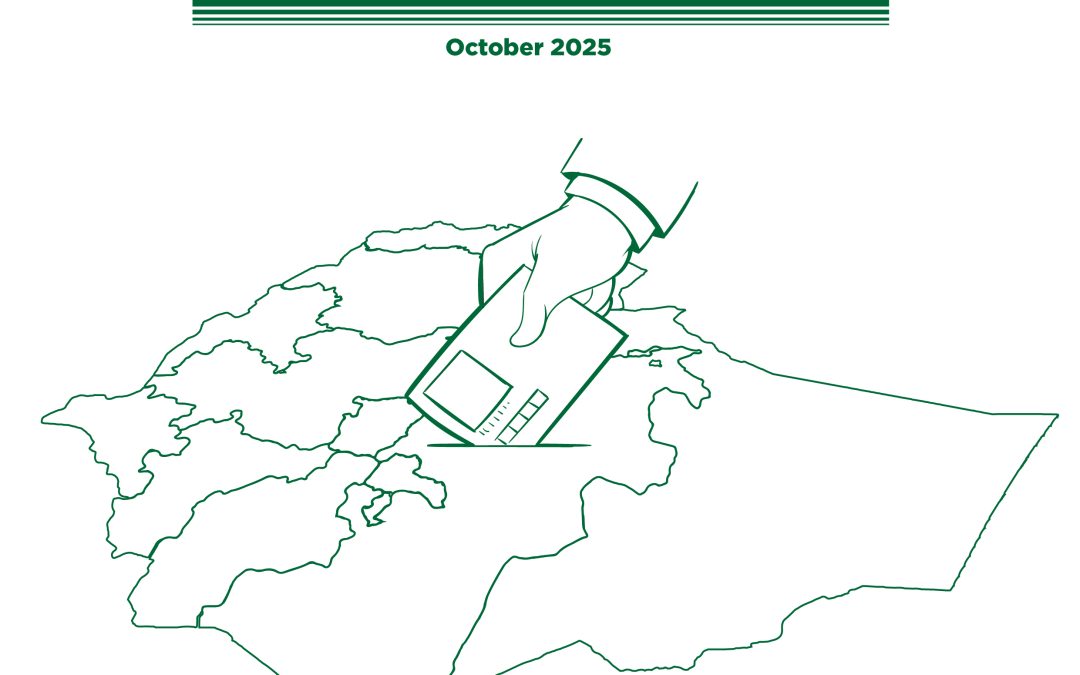
Electoral Constituency Arrangements for Ethiopia’s House of Peoples’ Representatives: The Impact of Administration Boundary Changes and Absence of Population Census
This assessment, Electoral Constituency Arrangements for Ethiopia’s House of Peoples’ Representatives: The Impact of Administration Boundary Changes and Absence of Population Census, assesses the effectiveness of Ethiopia’s current electoral constituency delimitations. The study focuses on the impact of two main issues: the lack of a recent nationwide population census and continuous changes to administrative borders.
Key Findings:
- Outdated Delimitation and Malapportionment: Ethiopia continues to rely on electoral constituency boundaries established in 1994, which were based on projections from the 1984 census. Despite a 2007 census, the constituencies were never revised. This has led to significant malapportionment, where constituencies vary greatly in population size, potentially violating the “one person, one vote, one value” (OPOVOV) principle and undermining representation.
- Impact of Administrative Changes: Continuous changes to administrative boundaries since 1994, through referendums and regional restructuring (e.g., in Begi, Mieso, Wondo Genet, and the creation of Sidama, Central Ethiopia, South Ethiopia, and South West Ethiopia Peoples’ Regions), have caused some voters to cast votes in constituencies outside their administrative boundaries, sometimes even in another Regional State. This severs the link between local administration and national representation.
- Weaknesses in the Legal and Procedural Framework:
- The process lacks impartiality, as the House of the Federation (HoF) delimits constituencies based on a proposal from the National Election Board of Ethiopia (NEBE), rather than an independent, non-partisan body.
- There is a lack of transparency and public consultation, with the law only requiring the “decided” constituency list to be announced 180 days before candidate registration.
- Laws regarding constituency revision are unclear and shallow. The FDRE Constitution links revision to census results (every 10 years), but the Electoral Proclamation makes revision a discretionary action (“may be rearranged”).
- The clear criteria for determining which minority nationalities and peoples require special representation (reserving at least 20 seats in the HoPR) by the HoF are still overdue, leading to uncertainty and potential disenfranchisement, as seen in the West Omo Zone case.
Strengths Identified:
- Simplicity and Stability: The single-member constituency system is easy for voters to understand and promotes a strong link between representatives and their constituents.
- Alignment with Administrative Boundaries (Initial): The initial 1994 delimitation used Woredas as a basis, which theoretically aligns with geographical communities of interest.
- Managed Deviations (Theoretically): Current electoral law allows for a maximum average population deviation of 15% between ordinary constituencies, although this provision has not been applied yet due to the lack of revision.
Key Recommendations:
- Ensure Impartiality: Establish an independent and non-partisan boundary commission or authority with constitutionally guaranteed independence and final decision-making authority on technical delimitation.
- Periodic Revision: Mandate the revision of constituency delimitation through a statutory interval (e.g., every 10 years).
- Event-Based Triggers: Introduce legal reform to make a significant population deviation (e.g., 15%) automatically trigger a review of constituency delimitations.
- Ensure Public Participation: Develop a legal framework that establishes a structured public consultation process, including timely publication of draft maps, accessible public hearings, and a mechanism for submitting grievances to the judiciary.
- Develop Clear Criteria for Minority Representation: The HoF must develop, adopt, and publicize clearly defined, comprehensive, and objectively verifiable criteria for special representation that go beyond population numbers.
- Address Administrative Boundary Misalignment: Legislation should stipulate that substantive changes to administrative boundaries automatically trigger a review for realignment of electoral constituency boundaries within a specified timeframe.
- Resource Allocation: Allocate adequate financial, technical, and human resources to the NEBE (or new delimitation body) and the Ethiopian Statistics Service for conducting censuses and managing the delimitation process.