Jan 9, 2025
Executive Summary
This report provides an analysis of media coverage and portrayal of women across various Ethiopian media platforms from April 2024 to November 2024. Employing a mixed-methods approach, including quantitative and qualitative techniques, the monitoring encompassed radio, television, print, and online media. The media monitoring used content analysis to examine media messages and themes, selecting twelve diverse media Programs for detailed review.

Jan 9, 2025
Executive Summary
This report provides an analysis of media coverage and portrayal of women across various Ethiopian media platforms from August 2023 to March 2024. Employing a mixed-methods approach, including quantitative and qualitative techniques, the monitoring encompassed radio, television, print, and online media. The media monitoring used content analysis to examine media messages and themes, selecting twelve diverse media Programs for detailed review.
Nov 8, 2024
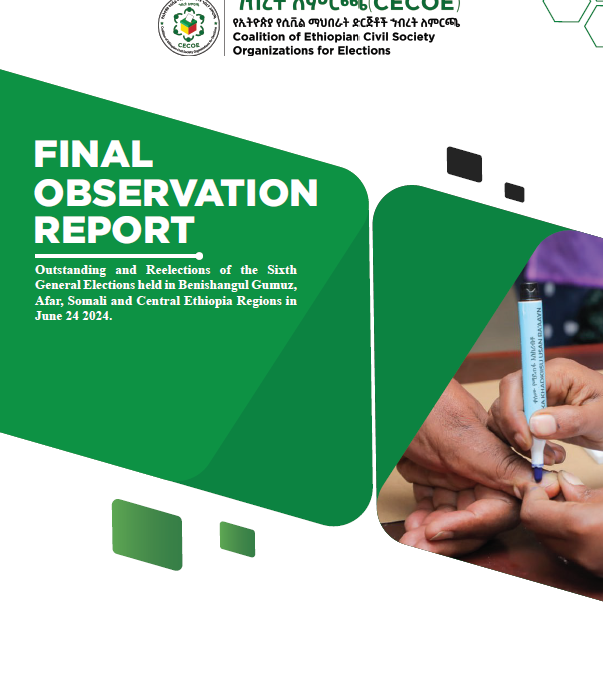
The Coalition of Ethiopian Civil Society Organizations for Elections (CECOE), a non-profit, nongovernmental organization committed to promoting democratic elections in Ethiopia, conducted an observation mission for the outstanding and re-elections held on June 24, 2024. These elections took place in specific constituencies within four regions: Benishangul Gumuz, Afar, Central Ethiopia (Meskan and Mareko constituency), and Somali (Jigjiga constituency). The mission aimed to assess the electoral process’s transparency, accountability, and adherence to democratic principles. This executive summary presents the key findings and recommendations stemming from the observation mission.
CECOE deployed 13 long-term observers (LTOs) from June 1st to June 30th, 2024, to observe the preelection environment and provide comprehensive insights into the electoral landscape. On election day, CECOE deployed an additional 77 stationary observers strategically placed across the four regions, using a combination of proportional and convenience-based deployment strategies to maximize coverage within operational constraints.
The observers utilized standardized checklists and reporting forms to systematically collect data on various aspects of the electoral process, including voter education, campaign activities, polling station setup, voting procedures, counting, and the post-election environment.
Jul 3, 2024
The Coalition of Ethiopian Civil Society Organizations for Elections (CECOE) is a coalition of over 175 indigenous civil society organizations. CECOE is an independent citizen’s election observation group whose main objective is to contribute to making elections held in Ethiopia comprehensive, transparent, accountable, and inclusive.
The political reform process that began in 2018 led to various legislative and institutional reforms, including revising the electoral law, reestablishing the National Elections Board of Ethiopia (NEBE), revisiting the political parties registration systems, and changing the overall electoral landscape ahead of the sixth general election. Despite these efforts, the reform faced challenges,due to conflicts that took place particularly in Tigray, in some parts of the Oromia, Amhara, Benishangul-Gumuz, and Afar regions, which impeded not only the democratic reform process but also adversely affected the conduct of the 2021 general elections in the named regions. Additionally, the NEBE canceled election results in some constituencies in the former South Nations, Nationalities and Peoples’ Region (SNNPR) and the Somali region due to serious irregularities found in the electoral process. As a result, some seats in the Federal Parliament and regional counsels are vacant..
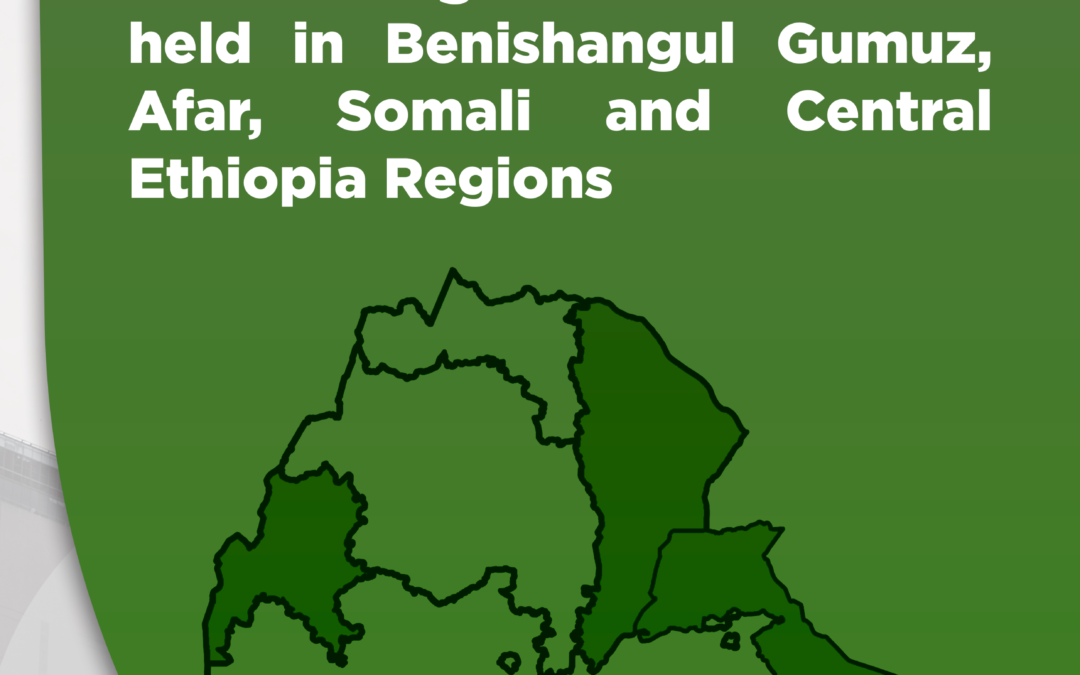
Considering the importance of organizing elections in the areas where the sixth general elections did not take place and constituencies where a decision for re-election was given, particularly in the Benishangul Gumuz, Afar, Somali and Central Ethiopia regions, the NEBE announced that it would organize outstanding elections and the re-election of the sixth general elections in the four regions.
On April 8, 2024, the NEBE issued an electoral calendar, setting the voting day for June 13, 2024. This date was again pushed to June 16, 2024,. However, June 16, 2024, as a voting day, coincided with the Muslim holiday of Eid al-Adha, which forced the NEBE once again to push the voting day to June 23, 2024. According to the NEBE, 1258 polling stations will be established (578 polling stations in Benishangul, 388 PS in Afar, 123 in Somalia, and 169 in Central Ethiopia).
Summary of findings
The main objective of observing the remaining elections and re-elections conducted on June 23, 2024, was to contribute to increased transparency and accountability in the electoral process by providing systematically gathered information. To achieve this end, CECOE deployed stationary observers (STOs) on Election Day who arrived at their assigned polling stations by 5:30 a.m. The STOs were required to observe the entire process of the voting day at their assigned polling station until the announcement of results.
Availability of electoral materials
The observation findings across regions where elections took place show that, except in the Somali region, where a grievance submission form was missing, all election materials were readily available in the rest of the polling stations where CECOE deployed its observers. In this regard, NEBE has accomplished a commendable job by making electoral materials available on time compared to previous experiences.
Accessibility of polling stations
The accessibility of polling stations encourages marginalized segments of society to participate in the electoral process, reduces their disenfranchisement, and thereby contributes to increased voter turnout. The observation findings, which are common across all regions where CECOE deployed observers, show that polling stations were accessible to persons with disabilities (PWDs), pregnant women, women with children, and elderly people. This is another positive improvement worth mentioning.
Gender composition and number of election officers
Observation findings on the number and gender compositions of poll workers cut across the regions where CECOE deployed observers. In almost all the polling stations, CECOE observed the number of poll workers to be five, which is consistent with the electoral law. Observation findings further revealed that out of the five poll workers, at least two were female. In some polling stations, female poll workers served as the chief election officers. Although deploying a minimum of three election officers in a polling station is legal, deploying five observers, at least, in polling stations CECOE observed fully satisfies the requirements of the electoral law and hence is laudable. Consistently satisfying the requirement is in compliance with the electoral law. On the other hand, there is still a room for increasing the proportion of female chief election officers.
Shelter
The availability of shelter outside polling stations is critical to protecting voters in queue from rain and sun. One important consideration while setting up polling stations is whether there is a place for voters waiting in line to shelter from the sun and rain. This is even more important when elections take place during the rainy season, which is often the case. In the event of rain, voters are highly likely to flee and thereby lose their rights to vote. CECOE’s observers deployed in the four regions reported that the majority of polling stations did not have adequate shelter for voters.
Grievance Hearing Committees
The electoral law empowers the NEBE to establish three-member grievance-hearing committees at polling stations, among others. However, in the majority of polling stations CECOE observed, except for the Jigjiga two polling stations (ጅ 06 ምርጫ ጣቢያ 02 and ጅ 04 ምርጫ ጣቢያ 03), which were established in accordance with the law, the committees that were established to hear grievances in the remaining polling stations were either inconsistent with the electoral law or they were not established at all.
Campaigning and Presence of unauthorized persons in polling stations
One of CECOE’s observation findings show that in one polling station ((ጅ 09 ምርጫ ጣቢያ ዞን-3/ሐ),) in Jigjiga, individuals campaigning for the Prosperity Party were observed within 20 meters of the polling stations, contrary to the electoral law, which strictly prohibits campaigning within a 200-meter radius of the polling stations. Similarly, in Afar, during voting, unauthorized individuals, more specifically, Kebele officials were present inside the “ገዋንኔ 01 ምርጫ ጣቢያ 01 ጋልኤብ ለ” polling station.
Voting Without Proof of Identity
Several individuals at two polling stations in Assosa zone (አሶሳ 03 ምርጫ ጣቢያ 03 03 ሀ 2 and ቡልደግሉ 01 ምርጫ ጣቢያ ቡልደግሉ ከተማ 01) were allowed to vote while their names were not on the voter roll, on the ground of disability or age. Additionally, contrary to the established electoral procedures, in one polling station in the Afar region (ገዋንኔ 01 ምርጫ ጣቢያ ጋልኤብ ሀ), voters were allowed to vote without presenting either proof of identification or the testimony of witnesses.
Failure to mark voters’ finger with an indeclinable ink
While the electoral law requires marking voters fingers with an indelible ink prior to voting, seven voters were allowed to vote at one polling station in Assosa zone (አሶሳ 02 ምርጫ ጣቢያ 02 02 ሀ 1B) without marking their fingers with the indelible ink. Similarly, in Afar region 11, 8, and 6, individuals voted without marking their fingers with indelible ink at three polling stations (አዋሬ ና ለምለምነን ምርጫ ጣቢያ ደንገባዲስ, ሃዶና ቢዳሪ ምርጫ ጣቢያ ሃዶ, and ከልዋን 01 ምርጫ ጣቢያ ከልዋን ከተማ), respectively.
Interruption of vote counting
Due to the delay in communicating NEBE’s announcement of the extension of the voting hours to 8 p.m., vote counting was interrupted in several polling stations in Assosa zone, namely,,አሶሳ 03 ምርጫ ጣቢያ 03 03 ሀ 2, አሶሳ 01 ምርጫ ጣቢያ 01 ሀ 2A, አሶሳ 02 ምርጫ ጣቢያ 02 02 ሀ 1B, and አሶሳ 01 ምርጫ ጣቢያ 01 ለ 2ፈንቲግራራ ምርጫ ጣቢያ ጉለሊ

Jan 2, 2024
Introduction
The Coalition of Ethiopian Civil Society Organizations for Elections (CECOE) was established in 2019 to augment and coordinate Ethiopian CSOs’ role in election observation – monitoring, voter education, and preventing post-electoral conflicts. Following its establishment, the CECOE opened a new chapter in the country’s CSO sector by systematically observing the Sidama Referendum in the same year of the coalition’s establishment. Building upon this experience, during the Sixth National and Regional Elections of Ethiopia, CECOE recruited and deployed over 3,500 long-term and short-term observers to nine Regional States and two City Administrations in the June and September 2021 elections as well as the South West Ethiopia Referendum for a status of statehood. Furthermore, CECOE has also successfully observed the referendum held in the six zones and five special woredas of the former Southern Nations, Nationalities, and People’s Region (SNNPR) in February 2023 and the Wolaita referendum re-run on June 19, 2023.
Recognizing the critical importance of the National Electoral Board of Ethiopia for the democratization process in Ethiopia, and the appointment of a new Chairperson for NEBE, CECOE has closely monitored the nomination, selection, and appointment processes.
This report offers a detailed examination of the nomination, selection, and appointment process for the new Chairperson of the NEBE, and its compliance with the existing legal framework based on media reports and press releases by the nomination committee on the process. while emphasizing key requirements such as transparency, inclusivity, and participation. This report also provides concrete recommendations to enhance future appointment processes, aiming to uphold democratic principles, foster public trust in the electoral system and the NEBE, and contribute to an open and informed public discourse surrounding the nomination, selection, and appointment of the new NEBE Chairperson. This will contribute to ensuring the integrity and legitimacy of future elections in Ethiopia.