- Background and Overview
CECOE is a non-profit, non-governmental civil society organisation comprising over 190 member organisations. CECOE was licensed by the F.D.R.E. Authority for Civil Society Organisations (ACSO) in 2019 with registration number 4748 under the Civil Society Organisations Proclamation 1113/2019, to enhance and coordinate the role of Ethiopian CSOs in election observation, voter education, preventing electoral conflicts, and providing capacity building and support for its member organisations. CECOE is a member of the East and Horn of Africa Election Observers Network (E-HORN), the African Election Observers Network (AfEONet), and the Global Network of Domestic Election Monitors (GNDEM), which connects regional networks and individual monitoring organisations across more than 88 countries worldwide.
Since its establishment, CECOE has conducted observation missions for various electoral events. These missions include the Sidama referendum, the 6th General Election, the South West Peoples Region referendum, the South Ethiopia Region referendum, the Wolaita Sodo referendum rerun, the outstanding and re-elections in Benishangul Gumuz, Afar, Somali, and Meskan and Mareko, and the 7th General Election. For these missions, CECOE has deployed over 6,000 observers.
Under the Civil Society Innovation Fund II (CSIF II) program, CECOE, in a consortium with Ethiopian Women Rights Advocates (EWRA) and Bright Future, is implementing the project entitled "Promoting Democracy, Civic Engagement, and Human Rights in Ethiopia through Strengthening Civil Society Actors". Through this initiative, CECOE is launching a small grant scheme for host CSOs operating the regional "Bqu Zega" Hubs.
This specific call utilizes the Inter-Regional Peacebuilding Initiative (IRPI) framework to help host CSOs identify, brainstorm local community challenges, undergo capacity-building training, and subsequently design and submit their final project proposals.
- Objectives and the Training-to-Proposal Pathway
The primary objective of this sub-grant is to empower communities and regional civic actors to address local challenges and contribute to conflict-sensitive inter-regional peacebuilding.
To ensure that projects are deeply rooted in context and evidence, final project proposals will be submitted only after host CSOs undergo capacity-building training. The training will guide applicants through a structured pathway: -
Understand → Analyse → Dialogue → Collaborate → Design → Act → Reflect.
Applicants will fulfill the following core requirements:
- Actively Participate in Capacity Building:- Engage in the peacebuilding and conflict analysis training to detail diagnose community challenges before drafting the final project proposal.
- Activate "Bqu Zega" Hubs:- Utilize the established civic cafe hubs to cultivate an empowering environment for youth and community members to collectively identify and resolve community challenges.
- Inter-Regional Collaboration: Work within geographically interconnected clusters (Afar–Amhara–Tigray; Somali–Oromia–Afar; Benishangul-Gumuz–Amhara–Oromia) to develop joint conflict prevention and peacebuilding projects.
- Integrate E-Learning:- Leverage the project's "Bqu Zega" E-learning system and civic education modules to expand knowledge accessibility, collaborating to build upon current civic education materials and ensuring digital training is integrated with other educational programs.
- Hub Accessibility:- Ensure that "Bqu Zega" Hubs are fully accessible to diverse community members to maximize the reach of civic engagement initiatives.
- Innovative Framework for Proposal Development
Throughout the capacity-building stage, host CSOs are expected to leverage the IRPI Manual to brainstorm and structure their project proposals. Applications must incorporate and demonstrate the application of the following core analytical instruments:
- Practical Conflict Analysis Tools: Proposals must apply analytical methodologies such as Conflict Tree Analysis to examine root causes, core issues, and overall impacts. Submissions should also feature key actor mapping, power-versus-interest assessments, and a clear determination of existing dividers and connectors.
- Conflict Dynamics Assessment: Applicants are required to differentiate clearly among structural root causes, proximate drivers, and immediate triggers. Proposed actions must be tailored to target the relevant stage of the conflict cycle, such as escalation or de-escalation phases.
- Peacebuilding and Conflict Transformation: Projects must showcase a comprehensive grasp of positive peace, prioritizing the development of attitudes, institutional frameworks, and social structures that support sustainable peaceful societies, rather than merely addressing negative peace or the temporary absence of violence.
- Eligibility Criteria
To be eligible for the initial selection and subsequent funding under the CECOE Sub-Grant Fund manual, applicants must meet the following criteria:
- Must be a legally registered CSO actively operating in Ethiopia, backed by a letter of support verifying ongoing community engagement.
- Must maintain active membership status within CECOE, including full compliance with financial obligations such as timely contribution settlements. (Please note: for this specific call, eligibility is restricted exclusively to the previously identified host CSOs.)
- Must demonstrate thematic focus and alignment with CECOE's strategic priorities, specifically focusing on innovative civic engagement and peacebuilding.
- Must demonstrate the technical capacity to implement the proposed project and participate in the required capacity-building training.
- Must demonstrate sound financial management systems and practices.
Exclusion Criteria: Host CSOs will be excluded if they fail to renew their operating license, are guilty of grave professional misconduct, or have shown significant deficiencies in previous sub-grants.
- Eligible and Ineligible Costs
All proposed budgets must adhere to the financial requirements detailed in the CECOE Sub-Grant Manual.
- Allowable Costs: Direct costs of the project, consultancy costs (with prior Terms of Reference and CVs), transportation, space rental (non-grantee owned), conferences/workshops, printing, and specific capital equipment.
- Unallowable Costs: Purchase of property, compensation of government employees, bonuses or commission payments, fines and penalties, sports expenses, and costs incurred outside the grant period.
- Evaluation and Selection Process
Proposals submitted after the capacity-building training will be evaluated by the Sub-Grant Committee (SGC) based on a 100-point scale:
For sub-grants greater than 1,000,000 Birr, the SGC may conduct a pre-award risk assessment to ensure the selected applicant has the necessary financial and operational systems in place.
- Effectiveness and Feasibility of the Action (Max 30 points): Appropriateness of proposed activities, clarity of the action plan based on the Conflict Tree analysis, and objectively verifiable indicators.
- Relevance of the Action (Max 25 points): Alignment with the program objectives, precise definition of target groups, and the integration of innovative methods for identifying community challenges.
- Financial and Operational Capacity (Max 20 points): Sufficient experience in project management and stable sources of finance.
- Sustainability of the Action (Max 15 points): Tangible impact on target groups, realistic risk identification, and institutional sustainability after funding ends.
- Budget and Cost-Effectiveness (Max 10 points): Appropriate reflection of activities in the budget and realistic pricing for goods and services.
- Application Instructions
Applicants must follow the standard formats outlined in the "CECOE- Sub Grant Manual". Application templates can be accessed via the CECOE Sub Grant portal at https://sub-granting.cecoe-tools.org/
- Required Documents: Applications must include the grant application form, simplified logical framework, budget, CSO Memorandum of Association, copy of ACSO registration, organizational profile/CV, signed financial statements of the immediate recent years, and a bank account in the name of the CSO.
- Currency Requirement: All budget projections and financial calculations submitted in the application must be presented exclusively in Ethiopian Birr (ETB).
- Project Timeline and Duration: The implementation period for the proposed project must be a minimum of 6 months up to a maximum duration of 10 months.
- Submission Deadline: The online portal will accept application submissions until the close of September 21, 2026. Late submissions will be strictly disqualified and excluded from the evaluation process.
Apply To Host CECOE Civic Engagement Hub
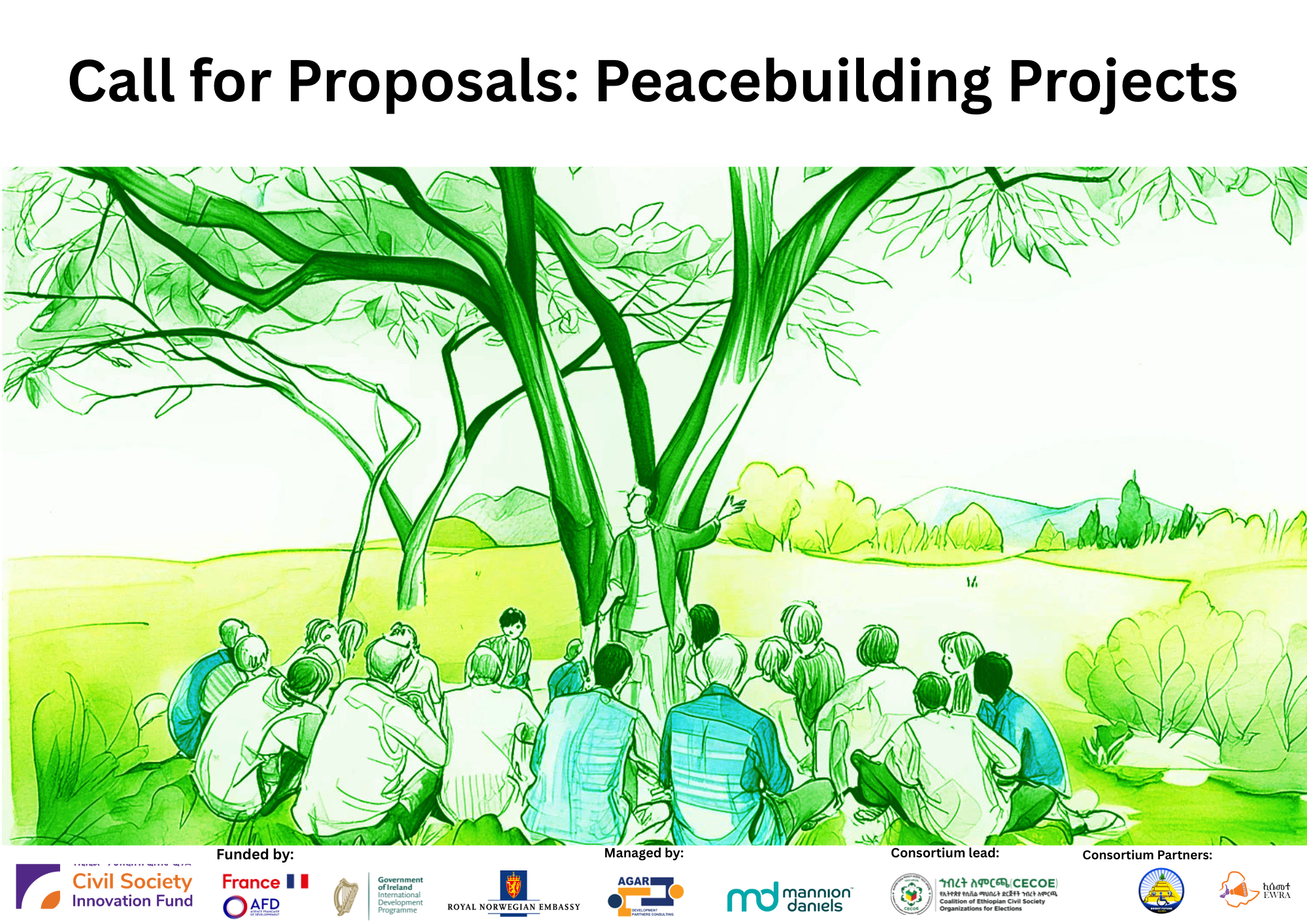
The selected Host Organization will manage a Regional Civic Engagement Hub designed to provide accessible civic education, serve as a Civic Café for community dialogue, and support inter-regional peacebuilding efforts.