CECOE has launched the Digital Election Observation Workspace (DEOW) to support and improve its election observation process. As CECOE continues deploying observers across the country, DEOW provides a more structured and efficient system for managing key processes — from recruitment to communication and reporting. The platform includes easier recruitment and management of observers, automated generation of checklists and certificates and samelined communication through broadcast and notification messages. From 27–29 April 2026, the CECOE team received training on the system management.
This was followed by an official handover ceremony between Executive Director Ato Abera Hailemariyam and Dr. Marco Hoase, Head of the Programme, Support to Good Governance (S2GG) Programme. In his remarks, Ato Abera highlighted the importance of this partnership, noting that DEOW will significantly strengthen and digitalize CECOE’s observation efforts — making them more advanced, organized, and impactful.
The platform is expected to improve coordination and timeliness in election observation activities of CECOE, while supporting the deployment of a larger number of observers. The development of DEOW was supported by the GIZ-implemented Support to Good Governance (S2GG) Programme.
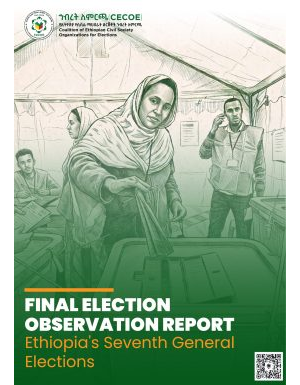
The Coalition of Ethiopian Civil Society Organizations for Election (Coalition for Election), under the accreditation obtained from the National Election Board of Ethiopia (NEBE), is observing the Seventh General Elections. The Coalition has deployed 522 long-term observers (LTOs) to observe the voter registration process across all Ethiopian regions and the two city administrations, Addis Ababa and Dire Dawa with the exception of the Tigray region and contested areas.
This report evaluates the voter registration process conducted by the NEBE —assisted by both manual and tablet methods—in a systematic manner using consistent observation checklists based on key indicators. This report primarily examines the voter registration process, its inclusiveness (participation of women, persons with disabilities, and the elderly), the deployment of security forces around registration centers, and election security.
The report covers the voter registration process from March 20, 2026, to the conclusion of registration on April 22, 2026. It is based on findings gathered from 3,953 manual and 443 tablet registration centers, totaling 4,396 centers where the Coalition deployed its 522 long-term observers. Any percentage (%) findings presented in this report are calculated relative to the 3,953 manual and 443 tablet registration centers observed by the Coalition.
Organization and Accessibility of Registration Centers
Location of Centers: Regarding the establishment of registration centers, 3,851 (97%) of observed manual centers and 429 (97%) of tablet centers were established in legally permitted locations. However, 102 (3%) manual and 14 (3%) tablet centers were established in prohibited locations (military, police, religious sites, health centers, bars/hotels, political party offices, and private residences).
Availability of Election Officials: The law stipulates that at least three (3) election officials must be present at registration centers. The Coalition’s observers confirmed an average of 4 officials were present at centers under both registration methods.
Opening Hours: 1,284 (63%) manual centers and 125 (56%) tablet centers began registration between 8:30 AM and 9:30 AM. Conversely, 762 (37%) manual centers and 98 (44%) tablet centers started between 9:30 AM and noon (6:00 local time). In 5 observed manual centers, the registration process had not begun by noon.
Lunch Breaks: Of the 1,902 manual and 220 tablet centers observed during the afternoon session, 1,702 (89%) manual centers utilized the legal one-hour lunch break, while the Coalition observed that 200 (11%) centers took more than one hour. Regarding tablet centers, 205 (93%) used the legal one-hour break, while 15 (7%) were found to have exceeded it.
Closing Hours: Among the centers observed in the afternoon, 1,686 (89%) manual and 193 (88%) tablet centers closed between 5:30 PM and 6:00 PM. Our findings show 137 (7%) manual and 17 (8%) tablet centers closed after 6:00 PM. Conversely, 79 (4%) manual and 10 (5%) tablet centers closed before 5:30 PM.
Interruption of Process: In 2,666 (67%) manual centers and 320 (72%) tablet centers, the registration process was never interrupted. Conversely, registration was interrupted at least once in 1,287 (33%) manual and 123 (28%) tablet centers.
Shelter from Sun and Rain: 2,324 (59%) manual and 268 (60%) tablet centers provided shelter (shade) to protect registrants from sun/rain. In contrast, 1,629 (41%) manual and 175 (40%) tablet centers had no such shelter. Convenience for Women: Regarding proximity to residence and safety concerns, 3,563 (90%) manual and 400 (90%) tablet centers were convenient for women; 390 (10%) manual and 43 (10%) tablet centers were not.
Accessibility for those with Limited Mobility: Only 437 (11%) manual and 88 (20%) tablet centers were accessible to registrants with limited mobility (the elderly, pregnant women, or parents with infants). Conversely, 3,516 (89%) manual and 355 (80%) tablet centers were not accessible to these community members.
Accessibility for Persons with Disabilities: The Coalition observed that 485 (12%) manual and 103 (23%) tablet centers allowed persons with disabilities to enter without assistance, whereas 3,468 (88%) manual and 340 (77%) tablet centers were inaccessible without assistance.
Observer Access: Coalition observers were allowed entry without restriction in 3,927 (99%) manual and 430 (97%) tablet centers. However, access was denied in 26 (1%) manual and 13 (3%) tablet centers.
Security Personnel: Security forces were observed outside 2,999 (76%) manual and 320 (80%) tablet centers. Regular police members were present outside 2,003 (51%) manual and 219 (49%) tablet centers. In the remaining 24% of manual and 32% of tablet centers, security forces other than regular police were present. In 25% of manual and 19% of tablet centers, neither police nor other security forces were present outside.
Incidents of Violence/Harassment: In 99.7% of manual and 99% of tablet centers, no violence, threats, or harassment occurred. However, incidents were reported in a small number of centers involving election officials: one (1) murder (East Gojjam, Amhara); two (2) attempted murders (Awi and Wag Hemra, Amhara); seven (7) abductions/kidnappings (2 in East Gojjam, 2 in Wag Hemra, 2 in West Wollega, Oromia, and 1 in South Omo, South Ethiopia); one (1) beating (North Sidama, Sidama); and six (6) threats (South Wollo, North Wollo, West Gojjam, South Gondar, and South Omo).
Voter Registration Process
Identification Documents: Legally, registrants must provide a Kebele ID, passport (even if expired), driver's license, military discharge papers, or student ID. In 3,451 (87%) manual centers, registration followed these rules. However, in 494 (12.49%) manual centers, between 1 and 20 people registered without providing these documents, and in 8 centers, more than 20 people registered without verifying identity/residency.
Digital Registration (OTP): For tablet registration, Fayda National ID holders should receive a One-Time Password (OTP) on their phones. In 424 (96%) tablet centers, OTPs were sent without disruption during observation. However, in 13 (3%) centers, 1–20 registrants did not receive an OTP, and in 6 (1%) centers, more than 20 registrants did not receive it.
Digital Registration (Fayda-less): In 412 (93%) tablet centers, officials successfully entered data (name, age, photo, etc.) for those without Fayda IDs. In 26 (6%) centers, officials were unable to enter data for 1–20 registrants, and in 5 (1%) centers, the system rejected evidence for more than 20 registrants.
Registration Cards: The law dictates cards must be issued immediately upon completion. This occurred in 97% of manual centers, but 111 (3%) centers failed to issue them immediately to 1–20 registrants, and 11 (0.2%) centers failed for more than 20 registrants.
Unauthorized Persons: Only registrants, Board officials, party agents, and accredited observers are allowed inside. This was respected in 98% of manual and 96% of tablet centers. However, unauthorized persons (Kebele leaders, security forces, local party coordinators) were found in 83 (2%) manual and 19 (4%) tablet centers.
Physical Presence: Registration must be done in person. While this was followed in most centers, 92 (2%) manual and 12 (3%) tablet centers registered individuals who were not physically present.
Inclusiveness
Gender Parity among Officials: On average, there was one female official out of the four per center. Women served as heads of 672 (17%) manual centers and 109 (25%) tablet centers.
Persons with Disabilities (Officials): Persons with disabilities served as officials in 93 (0.02%) manual and 15 (0.03%) tablet centers, including roles as center heads.
Female controllers/searchers were present in 97% of manual and 98% of tablet centers. They were missing in 4% of manual and 2% of tablet centers.
Assisted Registration Disclosure: The law requires that information for those registering with assistance be read aloud. This was practiced in 46% of manual and 37% of tablet centers but was ignored in 54% of manual and 63% of tablet centers.
Participation of Stakeholders
Political Parties: Party agents were present in only 539 (14%) manual and 61 (14%) tablet centers. They were absent in 86% of centers for both methods.
Civil Society: Excluding the Coalition’s observers, other observers were present in 156 (8%) manual and 52 (12%) tablet centers. They were absent in 92% of manual and 88% of tablet centers.
Strengths, Areas for Improvement, and Recommendations
Strengths
Preparation of a legal framework for digital registration, introduction of technology, and its implementation.
Over 5.5 million citizens registered through the digital option.
Over 50.5 million total voters registered, 46% of whom are women.
Most registration centers were established in legally permitted locations.
Observation that most centers were staffed by an average of 4 officials.
87% of observed centers required proper identification for registration.
Observer access was granted without restriction in over 97% of centers.
Areas for Improvement
Frequent interruptions in the digital registration system.
Establishment of a small number of centers in prohibited locations.
Instances of registration without identity verification or physical presence, and the presence of unauthorized persons.
Inaccessibility of many centers for persons with disabilities and those with limited mobility.
Incidents of murder, threats, and abductions against officials and voters by armed forces.
Recommendations
To the National Election Board of Ethiopia (NEBE):
Strengthen digital registration infrastructure immediately to resolve system interruptions.
Enforce identity verification and physical presence requirements; take legal action against those who violate these laws.
Strictly monitor and ensure registration centers are established only in permitted locations.
Ensure polling stations for Election Day are accessible to persons with disabilities and strictly follow the protocol of reading registration information aloud for those receiving assistance.
Improve election officials’ attendance and punctuality through continuous monitoring and training.
Ensure all centers provide shelter from sun and rain.
To Regional Governments:
Ensure polling stations are in legal locations, are accessible to persons with disabilities, and provide shelter as required by law.
To Security Forces:
Provide adequate protection to prevent threats and attacks against officials, voters, and observers.
Deploy regular police members outside polling stations for security.
To Political Parties and Civil Society:
Fulfill the responsibility of ensuring transparency, inclusivity, and accountability by deploying agents and observers on Election Day. the Coalition.
The Coalition of Ethiopian Civil Society Organizations for Elections (CECOE) is a non-profit and non-governmental civil society organization comprising more than 190 member organizations. CECOE was licensed in 2019 by the Federal Democratic Republic of Ethiopia Authority for Civil Society Organizations (ACSO) under registration number 4748, in accordance with the Civil Society Organizations Proclamation No. 1113/2019. The organization was established to enhance and coordinate the role of Ethiopian civil society organizations in election observation, civic and voter education, prevention of electoral conflicts, and capacity building for its members.
Since its inception, CECOE has observed the 2019 Sidama Region Referendum, the 2021 General Elections (June 21 and September 30, 2021), the 2021 South West Ethiopia Peoples' Region Referendum, the 2023 South Ethiopia and Wolaita Zone Referendum rerun, and the 2024 outstanding and re-elections in parts of the Benishangul Gumuz, Afar, Central Ethiopia, and Somali regions. Additionally, CECOE has engaged in various advocacy and civic education activities and implemented projects to strengthen democratic institutions and citizen participation.
In line with this principle, CECOE is in the process of establishing a Technical Advisory Committee to provide expert guidance on election observation for the upcoming 7th General Election. This Advisory Committee will serve as a standing resource pool of experts, offering high-level technical advice, analysis, and risk assessment to support CECOE's Board in ensuring accurate, neutral, and impactful election observation. Drawing inspiration from international best practices, such as those from CODEO in Ghana and ELOG in Kenya, the Committee will enhance the credibility of CECOE’s observation efforts by reviewing reports, advising on legal and security risks, and analyzing electoral incidents.
CECOE invites all citizens, civil society organizations, academic institutions, and professional networks to nominate qualified individuals (including self-nominations) for membership on this committee. This public call aims to ensure a diverse, merit-based selection process that prioritizes expertise, integrity, and representation from across Ethiopia.
Composition of the Advisory Committee
The Committee will consist of six (6) members, with one expert selected from each of the following fields:
Law (Electoral Law, Constitutional Law, or Human Rights)
Political Science (Political Analysis)
Statistics (statistician, Data Analysis )
Information Technology (Digital Security, Election Technology, or Data Systems).
Journalism and Communication (Strategic Communication).
Security Risk Assessment (Conflict Analysis or Safety Protocols)
Criteria for Membership
Nominees must meet the following minimum requirements:
An academic degree in one of the specified fields.
At least five (5) years of working experience in their area of expertise.
Demonstrated commitment to democratic principles, impartiality, and non-partisanship (no active affiliation with political parties, candidates, or government bodies involved in elections).
Strong ethical standards, with a track record of neutrality and integrity.
Diversity in gender, ethnicity, and regional representation will be prioritized to reflect Ethiopia's rich societal fabric. Members will serve voluntarily for a renewable two-year term without payment.
How to Nominate?
To self-nominate please submit the following documents: A Curriculum Vitae (CV) highlighting the nominee's qualifications, experience, relevant achievements and a Statement of Interest (1 page) explaining the nominee's motivation, how their expertise aligns with CECOE's mission, and their commitment to democratic election processes
If nominating someone else, include a brief note explaining why you believe they meet the above requirements, along with contact details so the CECOE secretariat can request the CV and statement of interest.
Submissions should be sent via email to info@cecoe.org . Please indicate the specific field of expertise in the subject line "Nomination for Advisory Committee.”
Deadline for Submissions
March 7 , 2026. Late submissions will not be considered.
Selection Process
All nominations will undergo a transparent, merit-based review:
Initial screening by the CECOE Secretariat to ensure the minimum criteria are met.
Evaluation by a vetting subcommittee, which may include interviews or reference checks.
Final recommendations submitted to the CECOE Board for approval.
Selected members will be notified by March 31, 2026.
Why Participate?
By nominating experts, you help strengthen Ethiopia's democratic processes. The Advisory Committee will play a vital role in contributing to the integrity of the 7th General Election, ensuring timely and professional observation that benefits all Ethiopians.
For inquiries or additional information, contact our Secretariat at info@cecoe.org
Coalition of Ethiopian Civil Society Organizations for Elections (CECOE)